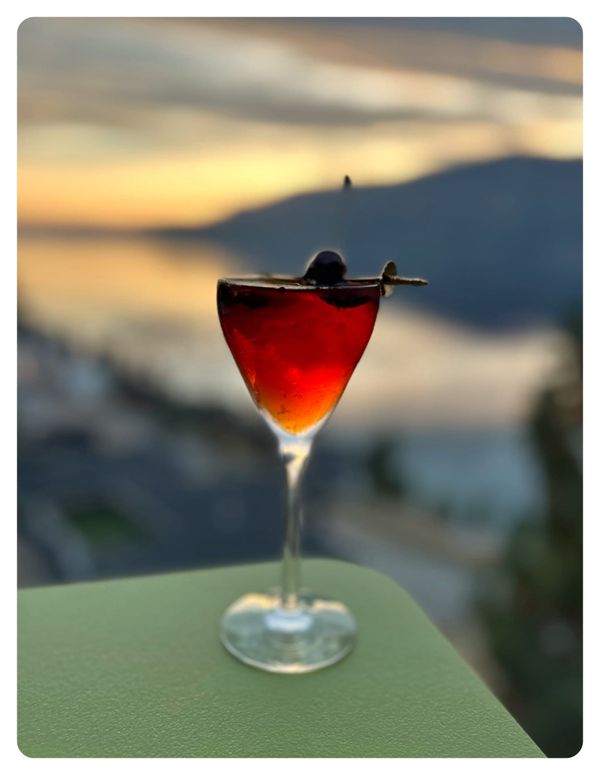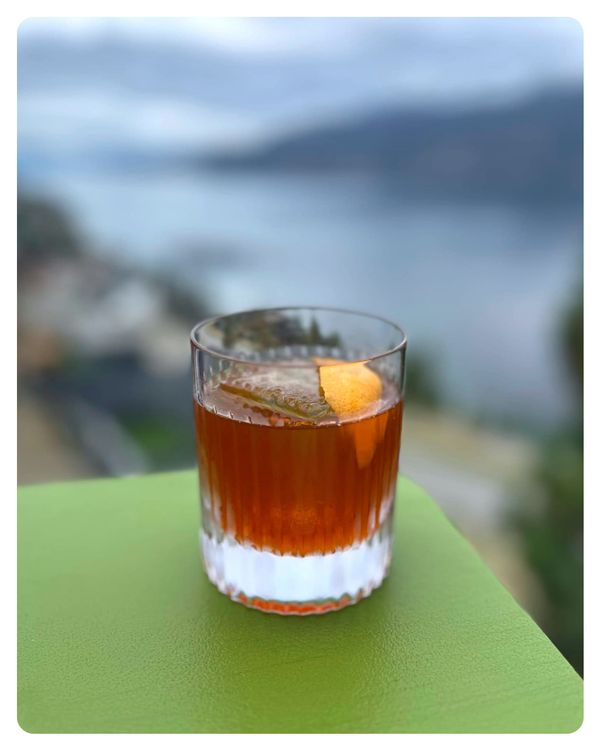
Initiand

- 1½ oz Dubonnet
- 1 oz Rhum Agricole Blanc
- ¼ oz Cointreau
- ¼ oz Peychaud's Bitters
- Stir with ice for 20-30 seconds, pour over a rock of ice into an Old Fashioned glass
- Original spec calls for no garnish, but orange zest works nicely
Happy Friday, friends!
With résumés ramping and applications flying after receiving my Canadian Work Permit last week, this Friday’s happy hour feels especially well‑earned.
So it’s with great pleasure that I introduce you to the Initiand.
A recent wine event at our home with some fellow Kelowna Newcomers Club members led to a book recommendation. One of our guests had moved back to Canada from France and suggested Drinking French–and who am I to turn down a region‑specific cocktails and spirits book? Flipping through the pages (I’ve yet to dive deeply), I landed on a chapter about Dubonnet–a bottle I’d had tucked away, unopened, in the back of my liquor cabinet.
Like many 19th‑ and early 20th‑century spirits, Dubonnet was originally developed with medical outcomes in mind. In 1846, the French government was looking for a more palatable quinine‑based apéritif for Foreign Legion soldiers in North Africa, and Joseph Dubonnet managed to create one that did the job. While it served its purpose in the field, it didn’t immediately ignite local civilian demand. Over time, though, it crossed the Channel and found fans in Britain–most famously Queen Elizabeth II, who enjoyed it mixed with gin.
In the mid–late 20th century, Dubonnet made its way into the U.S. market and, in 1972, tapped some young actors for an ad campaign aimed at a younger audience.
The renewed interest eventually attracted the attention of Heaven Hill, which acquired the brand for the U.S. market and adjusted the recipe to bring it closer (at least in intent) to the original. The current U.S. version uses a muscat base that lets the quinine peek through, and incorporates black currants and tea, aiming to approximate the green coffee beans, cinnamon, and chamomile found in the historic French formulation.
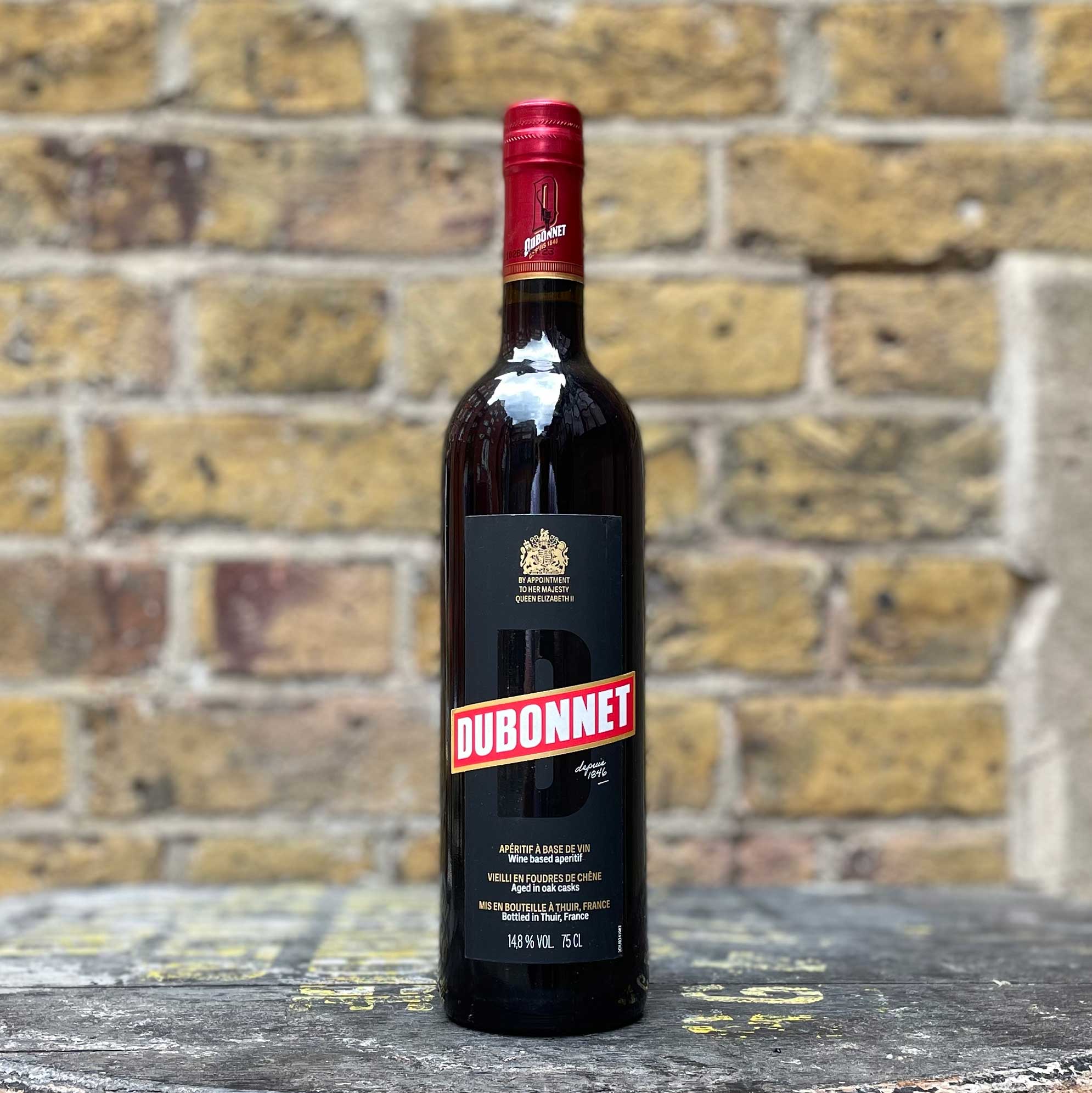
Not everyone agrees that the modern U.S. formulation hits the mark. Some drinkers find it overly sweet or reminiscent of artificial grape juice, sometimes noting a slightly “metallic” or “artificial” aftertaste. A bartender friend of mine was more colorful: he described it as “if Night Train and Mad Dog Electric Red had a baby with a bag of Franzia Zinfandel.”
On the hunt for a Dubonnet cocktail worth featuring here, I turned to The Dubonnet Cocktail Book by J.E. Clapham, an author you’ve seen on Flavor Notes before. That’s where I found the Initiand, a Clapham original.
The Initiand pairs Dubonnet with rhum agricole–for which I’m using the agricole‑style Paranubes Oaxacan Rum from Mexico, previously featured in the Cyrano. Paranubes brings intense notes of green olive, brine, pineapple, banana, and fresh‑cut grass. It’s earthy, funky, and complex all at once–a perfect sparring partner for Dubonnet.
A small measure of Cointreau adds bright, sweet citrus and subtle spice, helping to knit the components together and round the palate. Then, unusually, a relatively generous measure of Peychaud’s bitters steps in–not just as a finishing touch, but as a structural element. Peychaud’s contributes notes of anise and cherry, with subtle hints of clove, nutmeg, mint, and orange zest, deepening the bitter backbone.
On the nose, the citrus barely masks the agricole funk, giving you a glimpse of what’s to come. The first sip brings rum sweetness and fruity, citrus‑grape notes to the front of the palate. As the sip moves across, the quinine bite of the Dubonnet and the anise and baking spices from the Peychaud’s take over, providing structure and momentum. The finish is where the hogo funk of the agricole and the bitterness of Dubonnet and Peychaud’s stand tall, reminding you where you’ve been and hinting at where you’re going.
Whether you’re already familiar with a fortified quinquina like Dubonnet or just getting initiated, the Initiand is a worthy introduction.
With the AI revolution of the last few years, we’re all initiands in this new era–some more willingly than others.
I was running the Win‑Loss program at ZoomInfo when tools like ChatGPT started creeping into our processes and workflows. By the end of my time there, I was using multiple large language model instances to:
- write tailored executive summaries for different audiences
- push Win‑Loss insights into AI‑assisted engagement models to enable Sales
- identify and produce video snippets from interviews to generate VOC (voice‑of‑customer) insights
- and more across the insights stack
When ZoomInfo laid off about 6% of the company in June 2025—including me and nearly all of my teammates on the Product GTM (go‑to‑market) team–I read it, in part, as a consequence of the AI‑driven efficiencies we’d been piloting and scaling.
The CEO later spoke publicly and proudly about using AI to reduce the product marketing team from 26 people to 2, characterizing the function primarily in terms of content generation. As someone who’s spent a career in customer insights and go‑to‑market strategy, I’d argue that view underestimates the strategic side of the PMM role—but that debate is now playing out publicly, and I’ll let others litigate it in detail.
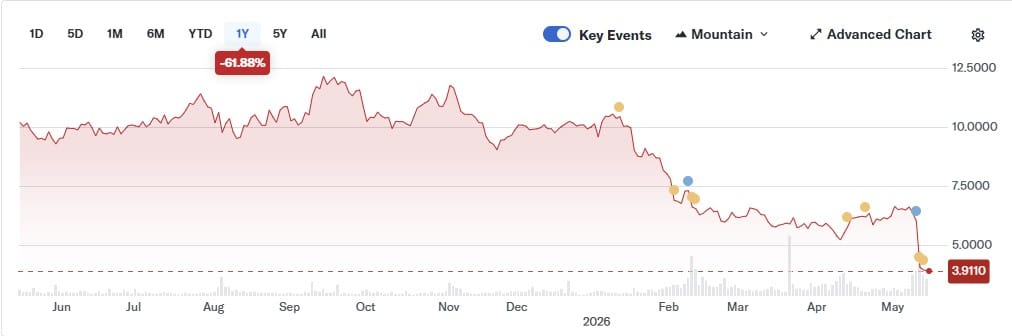
ZoomInfo announced further marketing‑side layoffs in early 2026 as they leaned harder into AI‑supported workflows. Then, on Monday of this week, they made an even larger move, laying off roughly 20% of the company (about 600 people) in a major restructuring, including closing their entire Israeli office.
Over the same period, the market has responded by taking the stock down sharply year‑over‑year. While leadership has framed some of this as the market not fully understanding AI or its long‑term value, my own hypothesis is that other structural trends in the category are at work as well.
In response to Monday’s news, Gal Ratner published a thoughtful article framing the company’s trajectory within broader changes in the go‑to‑market data space. One of his key points: AI has shifted the center of gravity in this category from the end‑user to the system of record. In other words, per‑seat SaaS pricing is not just theoretically challenged; it’s financially challenged.
ZoomInfo’s core product has historically been built for sellers, with a UI and workflow meant for individual sales reps. At the same time, Revenue Operations (RevOps) leaders and operations‑minded users have become increasingly central to buying decisions. Many of them don’t want sellers leaving their CRM–which they treat as the engine of record–to hop into separate tools.
As a result, a growing number of buyers don’t necessarily want a seller‑facing app at all. They want data feeds they can plug directly into the back end of the CRM and associated workflows. For those buyers, paying per seat for a UI their teams won’t use is a poor fit.
So yes, per‑seat pricing is under pressure partly because a growing share of the most sophisticated RevOps buyers don’t want to buy the packaging ZoomInfo has traditionally sold its data in. Against that backdrop, reasonably priced alternatives with “good enough” data, strong integration flexibility, and AI-driven workflows suddenly look very attractive.
Layer on the fact that annual revenue has effectively plateaued since 2023, and it’s hard to avoid the conclusion that ZoomInfo’s once‑differentiated data asset–the core of its category leadership–has been steadily commoditized.
At the same time, AI has been doing its own commoditization work, far beyond one company. Since 2025, hundreds of thousands of roles in the U.S. alone have been described as “impacted by AI‑driven efficiencies.” Titles in Product Marketing, Customer Insights, and Sales Enablement are now often framed as partially automatable, even when the underlying strategic work remains intensely human.
So, with all of that in mind, I raise this Initiand to my former teammates, near and far, who’ve been initiated into the AI era–whether they asked for it or not. May you find your next move, whether it lies in AI‑first workflows or with employers who still value pre‑AI craftsmanship in the disciplines we’ve spent careers building.
Cheers! ✨🎰🥃